Table of Contents
- 1 Santa Clara – Significant History Meets Impressive Art Scene
- 2 Video
- 3 Top Things to Do on a Map
- 4 1 – Museo Y Monumento Memorial Comandante Ernesto Che Guevara
- 5 2 – Monumento Al Tren Blindado (Train-Monument)
- 6 3 – Statue Che Con Niño
- 7 4 – Teatro La Caridad (Parque Vidal)
- 8 5 – Leoncio Vidal Park (Parque Vidal)
- 9 Transport
- 10 How To Get Around
- 11 Where to Stay
- 12 What to Eat in Santa Clara: A Taste of Revolutionary Cuba
- 13 Our Insider Tips on a Map
- 14 1 – Loma Del Capiro
- 15 2 – El Mejunje
- 16 3 – Bar La Marquesina
- 17 4 – Nightclub Boulevard
- 18 5 – Casa De La Ciudad
- 19 6 – Catedral De Santa Clara De Asís
Santa Clara – Significant History Meets Impressive Art Scene
A city of trends, creativity, and revolution – then and now. Santa Clara became famous and historic in December '58, when Che Guevara won the most important battle in the Civil War here, heralding the end of the Batista regime. Monuments are scattered all over the city; it doesn't get more historical and significant anywhere in Cuba.

Today, Santa Clara is one of the most vibrant and revolutionary cities. There is a large active artistic scene here, a graphic artists' collective that produces satirical political cartoons, and all of them have been testing the limits of the Cuban censorship police for years. Education in the classical sense is also not neglected; the Universidad Central Marta Abreu is one of the most prestigious universities in the country.

Trends are born in Santa Clara. No wonder, Cuba's first homosexual nightclub opened here, Cuba's only official drag show exists here, and the country's best rock festival is held here every year: Ciudad Metal. Santa Clara exudes history, revolution, passion, modernity, and color – an incomparable charm that you must experience for yourself.

- Tickets: Check out tours in Santa Clara
- Discover: More destinations and tour reports in our ultimate Cuba itinerary
Video
Top Things to Do on a Map
There is so much to see and experience in Santa Clara – madness. Since descriptions are unfortunately only in Spanish, we recommend booking a city tour. This way you can ask your guide everything and get a look behind the scenes – perfect in this creatively fascinating city.
- Tip: Plan at least 1 full day for Santa Clara, if you don't need big breaks. With 2 full days, it will be much more relaxed
- Discover: Get more information from our guide for Che Guevara Walking Tour
1 - Museo Y Monumento Memorial Comandante Ernesto Che Guevara
In the center is the colossal bronze statue of Che, in full combat uniform, with his arm plastered. He broke his arm during the decisive battle in Santa Clara. The engraved quotes from his farewell letter explain why he left for Bolivia for another revolution, later imprisoned and murdered. The museum displays some of his personal belongings, and his remains have been in the mausoleum since 1997. So are those of 38 of his comrades in arms, including Tamara Bunkes; she was the only woman who joined his struggle in Bolivia.
2 - Monumento Al Tren Blindado (Train-Monument)
It was on this very spot that history was made on December 29, 1958. When Che Guevara and his group captured an armored train. It is said that the train derailed as Che bulldozed 30 meters of railroad track, and it is this same train that can be seen on its own pedestal at the entrance. Opening hours are Tue – Sat 8:30 am – 5 pm + Sun: 9 am – 1 pm. The entrance fee is around 3 USD.

3 - Statue Che Con Niño
This life-size bronze statue shows Che Guevara with a little boy on his left arm. At numerous places, you will find small symbols representing his life, work, idiosyncrasies, and goals.

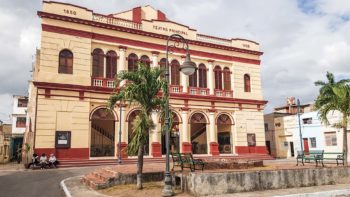
4 - Teatro La Caridad (Parque Vidal)
It is one of the few remaining colonial theaters in Cuba and is a national monument of Cuba. Built-in 1885 and financed entirely by Marta Abreu de Estevez.

5 - Leoncio Vidal Park (Parque Vidal)
Leoncio Vidal Park is located in the middle of the city and is a popular place. You can also find the famous statue El Niño de La Bota (The Boy with the Boot) and the statue of the local philanthropist Marta Abreu.
- Tickets: Book your Tour in Santa Clara online

Transport
Arrival By Plane
You can reach Santa Clara by plane. There are both national and international flights to the airport. From there you can get to the city by cab.
Arrival By Bus
You can arrive safely in Santa Clara by Viazul bus. The bus does not stop in the city center. If you have booked a Casa in advance, ask them to pick you up (for a fee) or take a cab – there are always some at the bus station. But as always, make sure you know the price beforehand.
- Tip: You can book bus tickets online at Viazul
How To Get Around
You can easily reach everything on foot within the city center, or you can take a bici-taxi or a carriage, they are everywhere.
Where to Stay
There are excellent hotels in Santa Clara. We recommend staying in a typical Cuban Casa Particulares in Santa Clara. You should not miss the insider tips and stories of the owners.
- Tip: Check out good hotels in Santa Clara and the largest selection of Casa Particulares in Santa Clara
What to Eat in Santa Clara: A Taste of Revolutionary Cuba
The food scene in Santa Clara mirrors the city's vibrant and revolutionary spirit. You'll find fewer tourist-centric menus and more opportunities to dive into authentic, traditional Cuban cuisine.
The best meals are often found in the family-run paladares or based on a recommendation from your Casa Particular host. The experience is as much about the lively atmosphere as it is about the food itself.
1. Ropa Vieja (Old Clothes)
This is Cuba's beloved national dish, and a must-try in a traditional Santa Clara restaurant. Ropa Vieja consists of shredded beef, slow-cooked in a rich and flavorful tomato-based sauce with onions, bell peppers, and Cuban spices.
The name “old clothes” comes from the way the shredded meat resembles colorful rags. It's the ultimate Cuban comfort food.
2. Moros y Cristianos (Moors and Christians)
You'll find this classic side dish served with nearly every meal. Moros y Cristianos is the iconic Cuban combination of black beans and white rice, cooked together so the rice absorbs the savory flavors of the beans and spices.
It's a simple but essential part of the culinary landscape and pairs perfectly with Ropa Vieja or grilled pork.
3. Tostones (Fried Green Plantains)
Forget French fries – in Cuba, the go-to savory side is Tostones. Green, unripe plantains are sliced, fried once, smashed flat, and then fried a second time until they are perfectly crispy on the outside and starchy on the inside.
They are typically served hot with a sprinkle of salt and are incredibly addictive.
4. A Strong Cuban Coffee or a Classic Cocktail
Coffee is an integral part of daily life in Cuba. Take a break from sightseeing and do as the locals do: find a spot at a café overlooking Parque Vidal, like the historic Bar La Marquesina, and order a strong, sweet Café Cubano.
In the evening, the same bars are perfect for enjoying one of Cuba's classic rum cocktails, like a Mojito or a Cuba Libre, while soaking in the city's vibrant atmosphere.
Our Insider Tips on a Map
1 - Loma Del Capiro
A viewpoint with a 360-degree view of Santa Clara. Not a strenuous walk, but it can get hot, so best to bring water and sunscreen. Che Guevara used the hilltop as a hiding place during the Battle of Santa Clara, so there is a small monument at the top of Loma del Capiro commemorating the battle.

2 - El Mejunje
An icon of the city and the LGBT center. Created by bohemians and intellectuals, it grew into a diverse and unconventional cultural space. It houses various artworks by Cuban political artists and gives a place for many local events. Once a year, the Cuban Pride Parade takes place here.
3 - Bar La Marquesina
In the corner of the La Caridad theater. Perfect for enjoying a coffee or a few drinks overlooking the main square.
4 - Nightclub Boulevard
A small club with a variety of shows, bands, and karaoke contests. Popular with the locals. Admission is about 4 USD.
5 - Casa De La Ciudad
Cultural center for local artists. Whether art exhibitions, traditional Cuban dance evenings, or music concerts in the courtyard. Workshops are also held regularly.

6 - Catedral De Santa Clara De Asís
It was the center of controversy in 1923, as it was actually built to replace the original church in the center of Parque Vidal. The cathedral has beautiful stained-glass windows and a mystical statue of the Virgin Mary. It disappeared without a trace shortly after its inauguration; decades later, it was found again in a ditch.
Share Now
Jetzt Teilen