Table of Contents
What is it Like in Cuba?
How did we imagine Cuba? Seniors smoking cigars with a glass of rum in their hands. Sitting comfortably in a rocking chair, on the veranda, with Cuban music playing in the background – Buena Vista Social Club, of course. Oh, and not to forget the famous classic cars: Cadillac next to Buick, Chrysler, Plymouth, and Studebaker – pure 50ies flair. Indeed, Cuba is exactly like that and yet completely different; it is magical.

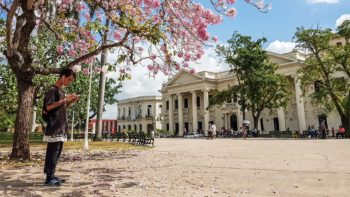
Cubans are sociable and love life, music, and dancing. Everyone meets in front of their houses and chats for hours with neighbors and friends. Children play soccer in the alleys, and in every park, life is raging. We also meet our seniors there, without rocking chairs and rum, but in the shade of the trees playing dominoes and chess – both national sports here, by the way.

Cuba's culture is extremely diverse and characterized by African, Spanish, French, and North American influences. But unlike the rest of the world, the time has stood still here. It is a journey into the past.

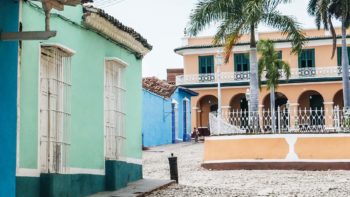
In really every city in Cuba, you'll find gorgeous colonial buildings, some lovingly restored and freshly painted. But most houses have not seen the paint bucket for a long time, crumbling paint and cracked windows are not uncommon, yet each one shines with character and tells its own story. The most photographed motif on the island? Definitely the classic cars. A dream come true for every car fan, and such a ride is something absolutely unique.

Why is it all like this? Cuba is one of the last countries with living socialism, a political exotic. Equality, justice, and solidarity – in theory, it sounds absolutely fair. In reality, what happened in 1959 was this: Castro designated Cuba as a socialist state. Citizens and companies of the United States were expropriated; after that, the U.S. imposed a trade, economic and financial embargo. A revolution with consequences – until today. In romanticized terms, it is the many old-timers, countless colonial buildings, no chains of fast food or fast fashion stores.

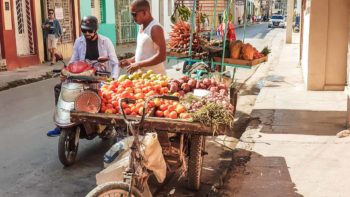
How does it feel to live between crumbling plaster and patina and lag behind the modern world? Even in Havana, you won't find an ordinary drugstore. Only corner stores without self-service, where one kind of shampoo stands next to rice and eggs. On the supermarket shelves, there are rather zero choices, and what is empty stays empty. The black market is booming.

Cuba is economically a poor country, especially outside the cities. But rich in memories of the independence struggles and revolution. On almost every house wall, countless billboards, or as statues, the two Castro brothers and Che Guevara can be found, along with slogans of perseverance.

Hard to imagine, but before the revolution, Cuba, especially Havana, was as glamorous and hip as Manhattan and Las Vegas. People partied exuberantly and gambled away or won millions in casinos. Stars and starlets were permanent guests, and designers first launched their collections in Havana.

But slowly, it is moving. For a few years now, Cubans have been allowed to run their own restaurants, so-called Paladares. More than one is now absolute famous, and you need a reservation. But to allow a little capitalism and at the same time hold on to socialism? That simply does not work.

Especially the younger generations can't relate to the revolution; they experience an enormous gap between reality and propaganda. Cuba offers excellent and free education, but it lags behind world standards in many respects, starting with salaries.

We often hear, “Quickly travel to Cuba before it changes.” After all, what country hasn't changed in recent years? Progress and change are important and good, especially for Cuba, a country that has struggled enough in recent decades. And yes, Cuba is in the midst of major changes. But the clocks there continue to tick slower – but with an insane amount of rhythm and nonchalance. In terms of society, family, and joie de vivre, Cuba has more to teach than to learn.
- Discover: More tips, highlights and tour reports in our complete Cuba itinerary
- Tip: Find here the Top 10 Things To Do in Cuba
Video
Best Time to Visit
- Tip: Pack enough sunscreen because it is tough to buy it locally; after-sun is also helpful
- Important: Between May and November is hurricane season in the Caribbean, especially in August, September, and October. Detailed information can be found at National Hurricane Centre
Entry Requirements
Visa
Other necessary Documents
You must have a return or onward ticket when you enter the country.
- Tip: If you want to stay flexible, you can also book a one-way flight and add a very cheap onward ticket
Travel Insurance
You need to have valid travel health insurance at the time of your entry. Furthermore, you may be required to provide written proof of coverage in Spanish, which you will receive from your insurance company. In addition, the period of insurance coverage must be explicitly stated and must be valid for the entire duration of the trip.
Customs
On the plane, customs declarations will be distributed, which you need to hand over to customs when entering the country. We can only advise you to declare everything because the luggage is scanned, and many things are not allowed, for example, a drone. You will have to hand it over to customs, so plan for a long wait (at least 2 hours).
- Tip: Check the latest customs regulations

Health
Vaccination
Get vaccination advice from your family doctor or the Tropical Institute before your trip.
Yellow fever vaccination is mandatory for all travelers coming from an acute yellow fever area. For Cuba, standard vaccinations such as tetanus, polio, diphtheria, and hepatitis A are recommended. Depending on the nature and duration of your trip, additional vaccinations may be recommended.
- Important: Make your appointment well in advance because some vaccinations take time
First Aid Kit
There are mosquito-borne diseases, such as dengue fever. You can protect yourself with long clothing and mosquito spray. You should also take sunscreen and after-sun. Pack your medicines and the common first-aid kit sufficiently because sometimes medicines are not in stock in pharmacies.
- Get the best First Aid kits in our Shop

Medical Care
The distances in Cuba are often long, and the roads are not in optimal condition, so a trip to a hospital takes longer. The foreigners' wards or hospitals are equipped with all the necessary common equipment, but they are not all up to the latest international standards. This is due, among other things, to the trade embargo. Cuban medical education is one of the best in Latin America.
- Important: Buy health insurance for the duration of your trip. This way, you are well covered and don't have to pay in advance for huge bills depending on the tariff
Tap Water
Don't drink the tap water because it tastes like chlorine. Brush your teeth and everything else you can do with it without hesitation.
Safety
Safety in General
Cuba is a safe country. What can happen is overcharging at the café. Negotiate the fare before any cab ride. The sidewalks are quite high and poorly lit in some places, especially at night, so be careful. In front of bus stations, people like to tell you that your booked accommodation is supposedly overbooked and want to find you another one.
Safety at Night
Cuba is generally safe at night. However, like almost everywhere in the world, you can be in the wrong place at the wrong time and be robbed of your money and cell phone. Depending on our gut feeling, we sometimes walked in the evening, sometimes we took a cab.
Safety for Solo Travelers
It is safe to travel solo through Cuba, even as a woman. Through the buses and Casa Particulares, you also get to know other travelers quickly and easily.
Safety Transport
Buses are safe in general, take your valuables with you and not in your regular luggage. For rental cars, store everything out of sight. Always find a valet parking spot – this applies at all times of the day. Do not take passengers/hitchhikers with you, and never pay fines in cash to a police officer; the car rental company will charge you for it. Do not drive in the dark because of low lighting.
Safety typical Cuba
Buy your cigars in official stores to avoid any fakes because they will be confiscated at customs.

Emergency Numbers

Police
106
Ambulance
104
Fire
105
- Tip: Want to know more about safety in Cuba? Find out more on Cuba on World Travel Index
Transport
How to Get There
Getting to Cuba is only possible by plane, but it is totally easy. Cuba has several airports and international flights from Europe, the USA, and Canada land daily. The airport in Havana is called José Martí.
Airport Transfer
You can organize a pick-up with your accommodation, or you can take a cab. These run at government-regulated fixed rates, and there are always plenty waiting outside the terminals. The drive to Havana takes 20-30 minutes and costs around 25 USD. The transfer between the terminals costs a flat rate of around 4.50 USD.
- Tip: Change money beforehand at the airport
How To Get Around
Cuba has the most unique transportation options in the world. Where else can you hit the streets first in a Lada and then in a 50s Mercury, Pontiac, Dodge, or Cadillac? But bring time; each ride can take longer in Cuba.
Long-distance bus
With the buses of Viazul, you can travel comfortably all over Cuba. Be there at least 20 minutes before departure and have your name checked off the list – this will confirm your seat. Be sure to pack your jacket/hoodie because the buses are air-conditioned.
- Tip: You can buy bus tickets at bus terminals and also at Cubanácan travel agencies. Viazul schedules and prices are available online at Viazul. Especially recommended in advance during high season.

Rental car
A rental car is perfect to be extra free and flexible. Car rental companies are all government-run in Cuba. The main ones are Transtur, Rex and Cubacar, and Havanautos. A rental car is not cheap in Cuba, and you always need to book in advance (ideally 2 months). The road conditions get worse, especially towards the east. It is not uncommon to meet pedestrians, bicyclists, horse-drawn carriages, ox teams, and free-roaming animals on the roads. There are few gas stations on the way, and because of the low lighting, you should rather not drive in the dark.
- Tip: Road signage and mobile signal are poor, so be sure to get offline maps of Cuba beforehand
Collective cabs /Colectivo and co.
Also called Maquina, Almendron, or Colectivo. A popular and cheap way to get to your destination. Some run only between fixed points; others pick up all passengers at their accommodation and stop at the destination at the desired address. You will always find colectivos near bus stations, and in central places, you will be approached by intermediaries, but your accommodation will also help you with the organization. As always, check the price in advance; it should not be much higher than a bus ticket.

Private buses / Camiónes
The cheapest way to get around is by camiónes – converted trucks. They are always full and very cheap. Comfort is absolutely absent; it can happen that you are standing for the whole trip. But it is easy to make friends with locals, and you are probably the only tourist far and wide.

Domestic flight
“Cubana de Aviacíon” and “Aerocaribbean” offer domestic flights. From Havana, you can get to Santiago de Cuba for about 130 USD. Unfortunately, there are often delays or cancellations, in which case substitute transportation by bus is organized. If you need to catch an onward flight, plan a day's buffer.
State Taxis
Cubataxi or Panataxi and a cab sign = government cab. Although they have a taximeter, it is typically not used. Therefore, clarify the price beforehand. In the city, 1 mile (1.6 kilometers) costs about 4.50 USD. Outside the city, the mile (1.6 kilometers) is between 1 USD and 1.20 USD. Some routes are cheaper with the state cab than the long-distance bus, and therefore a good alternative.
Train
Inside the Cities
Many cities in Cuba are perfect for exploring on foot. However, in almost every city, there are taxis and bici-taxis; these cute little bike cabs are super convenient for shorter distances.

Coco - Taxi in Havana
Yellow round motorcycle cabs that look like an orange. The little speedsters can reach up to 30 mph (50 km/h) and will cost around 1 USD for 1 mile (1.6 kilometers).

Habana Trans App - in Havana
The app knows all public transport connections. There are no fixed departure times, just like Cuban traffic. But knowing which line to take, and where the stop is, helps enormously.
- Tip: Download Habana Trans on Google Play for Android. It is not available for iOS
Bajanda - Uber In Cuban
The Bajanda app provides you with a driver who also transports small groups. Payment is always in cash. The rides are at a pre-set price.
- Tip: Download Bajanda on Google Play for Android or on Apple App Store for iOS
Language
In Cuba, Spanish is spoken superfast. Spanish knowledge is an absolute advantage because very few Cubans can speak English, and all signs are Spanish. But even without Spanish, you will reach your destination – we speak from experience – just using sign language.
- Tip: A dictionary, a dictionary without words, translation apps offline and offline maps help enormously
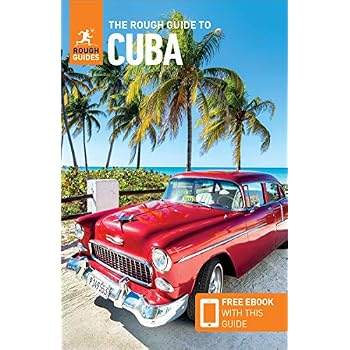
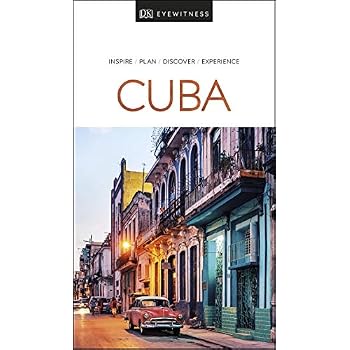
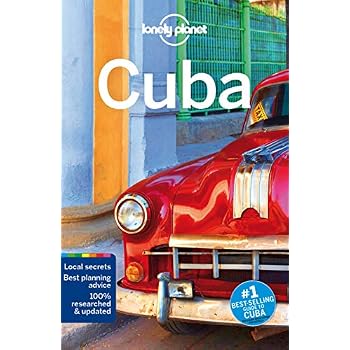
- Discover: Get the most popular travel guides in Paperback or Kindle version
Organized Tour or Independent Travel?
Organized Tour
The advantage of a group tour of Cuba? Your tour guide speaks Spanish. You don't have to worry about anything, and you travel together with others. There are round trips with small, medium, and large groups and the most different orientations: Sports, wellness, adventure.
Disadvantage? It is much more expensive and less authentic. Also, you are not flexible – places and times are fixed.
Independent Travel
You can travel in Cuba perfectly and uncomplicated individually. The transportation network is well-developed, and every city can be reached by bus. Even without knowledge of Spanish, no problem.
- Tip: Make at least a rough plan beforehand what you want to see because some routes drag on
How we traveled through Cuba
We traveled individually and only pre-booked the first 4 nights in Havana. We stayed in typical Cuban Casa Particulares. From city to city, we always took the buses of Viazul. We spent also 6 nights in Guardalavaca at a beach resort.
- Discover: Check out our ultimate Cuba itinerary
Money
Currency
The currency in Cuba is called Cuban Peso (CUP), which is also often called Moneda Nacional and abbreviated MN. Since Jan 1st, 2021, there is only one currency in Cuba; previously there were two.

Cash
In Cuba, cash is king. You can change money in many places, but never change money on the street because it is illegal. Official and common places to change money are the official exchange offices with CADECA written on them, banks and at the hotel – remember your ID.
- Tip: In Cuba, standing in line is a bit special: Cubans don't stand in lines. By asking, "Quien es el ultimo?" you will know who the last person is in line and when it is your turn
ATM & Credit Cards
You can pay with your credit card almost nowhere, except at the hotel, at the rental car agency, and in a few restaurants. You can theoretically withdraw money with your credit card. Americans with an American bank card cannot currently pay with their card.
Tipping
Cuba has a strong tipping culture, around 10% on top is excellent. At restaurants, in the hotel, the musicians on the street, or the cab driver – everyone is happy about tips. It puts little strain on the travel budget, but helps the Cubans enormously.
Accommodations in Cuba - Casa Particulares
Typically, Cuban accommodations are called Casa Particulares. Casa what? Casa Particulares is the name for a bedroom with its own bathroom in a house or apartment, which belongs to locals. The landlord lives in most cases there himself and rents one or more rooms to tourists. The accommodations are always huge, and you have your privacy.
The owner pays a fee to the government; for this, they need your passport and a sign. The Casas are perfect for meeting other travelers and getting to know Cubans better, plus you get first-hand tips. You can book meals as an option. We always had breakfast there. The owners are also happy to help you organize excursions, transportation, or your next accommodation. Of course, there are also hotels, but pay attention to the ratings because some are very outdated.
- Discover: Check out the largest selection of Casa Particulares in Cuba

Internet
Cuba has made huge leaps in the digital field in recent years. You have the choice of buying a SIM card either directly at the airport from ETECSA or alternatively in advance online.
Packing List
Power plug / Power data
- Plug / socket types:
- Mains voltage:
- Frequency:
- Type A, B, C and L
- 110 Volt (partly also 220 Volt)
- 60 Hz
- Tip: Get your universal power adapter in our shop
What to pack?
For your trip to Cuba, we have a few packing tips that are definitely worth their weight in gold. Because Cuba is not a shopping mecca, you will look in vain for drugstores or large supermarkets. There are small corner stores, but they have a very minimalist assortment.
- Sunscreen
- After-Sun
- Mosquito Repellent
- Shampoo and Co.
- Scarf or multifunctional cloth
- Snorkel Set
- Hygiene products for women
- Discover: Check out our ultimate packing list for Cuba
Share Now
Jetzt Teilen